






 Home
Home
 Products
Infection
Serum amyloid A (SAA)
Products
Infection
Serum amyloid A (SAA)
Serum amyloid A (SAA)
Key Product Characteristics
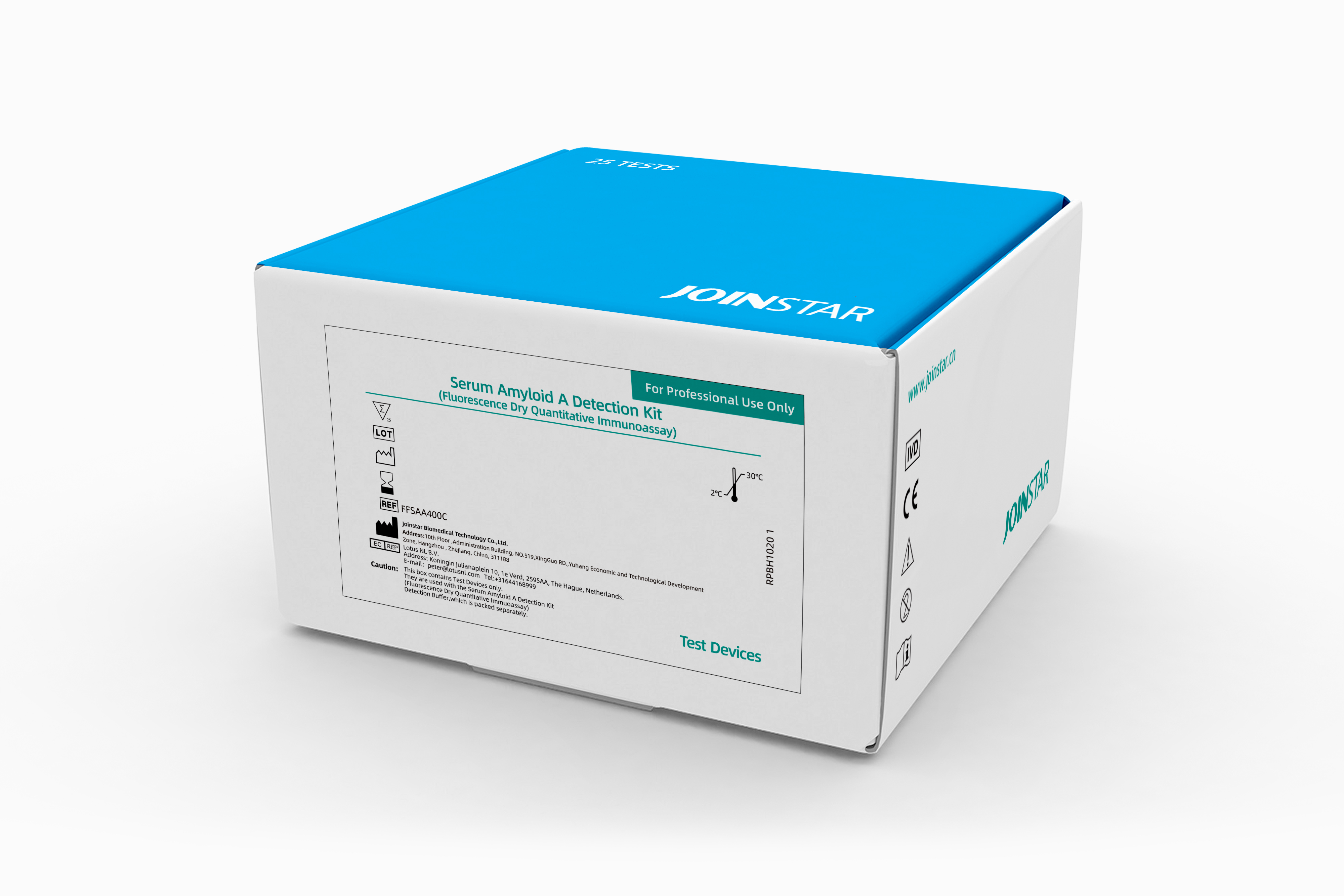
| Kit Name | Serum amyloid A Detection Kit |
| Method | Fluorescence dry quantitative immunoassay |
| Assay Measuring Range | 0.5mg/L ~ 300mg/L |
| Incubation Time | 5 min |
| Sample Type | Human serum, Plasma, Whole Blood (EDTA) |
| Reference Range | < 0.5 mg/L |
| Storage and Stability |
Detection Buffer: Stable for up to 18 months (Store at 2°C–8°C in a sealed, dark environment). Reaction Plate: Stable for up to 18 months (Store sealed at 2°C–30°C). |
Order Information
| Catlog No. | Product | Test/Kit |
| FFSAA400C | Serum amyloid A Detection Kit | 25 |

Introduction
• Serum amyloid A is produced in the liver and is highly conserved across species. It functions as an inflammatory and immunomodulatory protein, inducing inflammatory cytokine secretion, chemotaxis of neutrophils and mast cells and modulates immune responses. • It is an acute chronotropic protein that belongs to the heterogeneous class of apolipoprotein family and is present in trace amounts in healthy human blood. • In the acute phase response during inflammation, stimulated by IL-1, IL-6 and TNF, SAA can be elevated to 10-1000 times the normal value. • SAA is detectable within 3-6 h of infection and with a short half-life of 50 min. It is more sensitive than CRP, and the combination of these two markers can provide better differentiation of inflammation and infection. • In the acute phase of viral infections, SAA is elevated, usually to 10-100 ng/mL. however, in the acute phase of bacterial infections, SAA is elevated to a greater extent than in viral infections, even up to 100-1000mg/L.
Clinical Applications


Early blood biomarker for tissue injury and inflammation
Serum amyloid A (SAA) is an early and sensitive blood biomarker for tissue injury and inflammation and has been indicated in many inflammatory diseases.
The level of SAA circulating in the blood is known to increase dramatically in response to tissue damage or inflammation, classifying it as an acute phase protein.
Circulating SAA concentrations may increase up to 1000-fold following inflammation, infection, tissue injury and cell necrosis and decline rapidly following recovery.
Differential diagnosis of bacterial or viral infection
The level of SAA consistently higher than 10mg/L but lower than 100mg/L, suggests that viral infection is more likely.
The level of SAA consistently higher than 100mg/L highly indicates the acute phase of bacterial infection.
Monitoring the progression of infectious diseases
SAA can be used as an independent factor to assess the severity of bacterial, viral and other infectious diseases and inflammation, typically a level greater than 500 mg/L indicates a serious condition.
Combination detection of SAA and CRP
The level of SAA elevates in both viral and bacterial infections and is more sensitive to mild inflammatory stimuli than CRP. Therefore, a combination of SAA with CRP can provide clinicians with more information.
Prognostic evaluation of inflammation
Concentrations of SAA rapidly decrease after resolution of inflammation, making SAA measurement a useful tool for monitoring the course of inflammation in an individual.