






 Home
Home
 Products
Infection
C-reactive protein (CRP)
Products
Infection
C-reactive protein (CRP)
C-reactive protein (CRP)
Key Product Characteristics
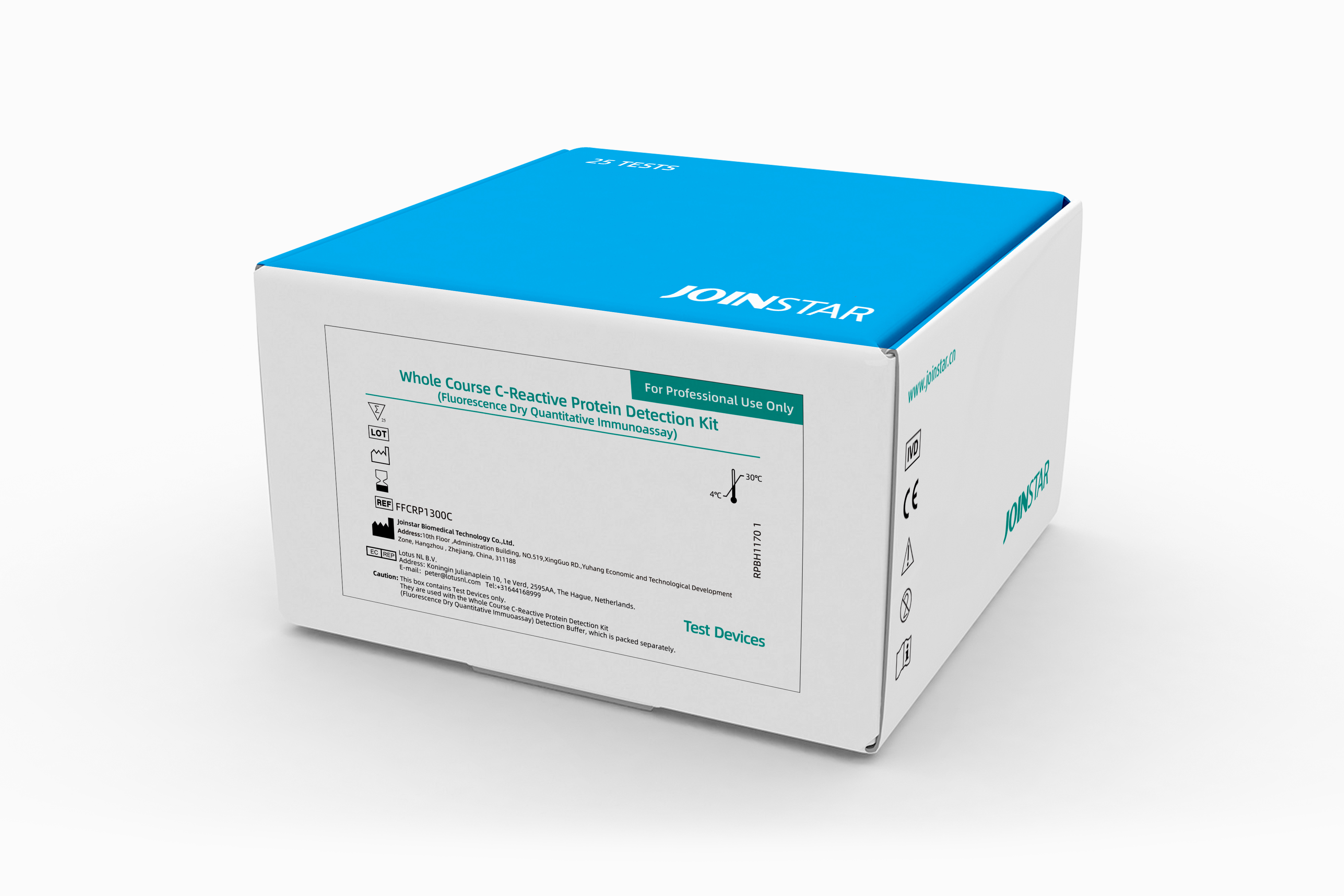
| Kit Name | Whole Course C-reactive Protein Detection Kit |
| Method | Fluorescence dry quantitative immunoassay |
| Assay measuring range | 0.5mg/L ~ 200mg/L |
| Incubation time | 3min |
| Sample | Human serum, Plasma (EDTA anticoagulant), Whole Blood (EDTA anticoagulant) |
| Reference range |
hsCRP for cardiovascular disease < 1mg/L; CRP for inflammatory disease <10mg/L |
| Storage and Stability |
Detection Buffer: Stable for up to 18 months (Store at 2°C–8°C in a sealed, dark environment). Reaction Plate: Stable for up to 18 months (Store sealed at 4°C–30°C). |
Order Information
| Catalog No. | Product | Test/Kit |
| FFCRP1300C | Whole Course C-reactive Protein Detection Kit | 25 |

Introduction
C-reactive protein (CRP) is a pentamer composed of five identical subunits bound in a non-covalent form and is one of the acute phase proteins synthesized by hepatocytes.
The level of CRP often increases 6-12 h after the initial onset of the infection or inflammation and reaches a peak in 24-48 h. The level of increase in CRP is positively correlated with disease severity .
In healthy individuals, the levels of CRP are usually low (<10 mg/L) whilst they increase in the presence of inflammatory disease, tissue damage, malignancy, surgical trauma, or coronary artery disease.
Hypersensitive C-reactive protein (hsCRP) can be used to assess the risk of cardiovascular disease. hsCRP <1.0 mg/L is considered low risk, 1.0-3.0 mg/L is considered moderate risk, and >3.0 mg/L is considered high risk.
Clinical Applications


Differential diagnosis of infectious diseases
CRP is a sensitive but nonspecific biomarker of bacterial infection. It is generally regarded as a more sensitive test than erythrocyte sedimentation rate(ESR)or white blood cell count(WBC).
Evaluation the effectiveness of antibiotic therapy
CRP is often used to evaluate the efficacy of antibiotics as it can respond to the changes during inflammation or infection.
Monitoring of postoperative infections
CRP can be used in the monitoring of serious surgical infections and postoperative complications.
Risk prediction for cardiovascular disease
hsCRP is an excellent biomarker of cardiovascular disease and as well as an independent and strong predictor of adverse cardiovascular events.
Other diseases
CRP is also used in the diagnosis and management of inflammatory diseases, such as Rheumatoid arthritis or Lupus, as levels go up in such conditions.