






 Home
Home
 Products
Diabetes & Kidney injury
β2-Microglobulin (β2-MG)
Products
Diabetes & Kidney injury
β2-Microglobulin (β2-MG)
β2-Microglobulin (β2-MG)
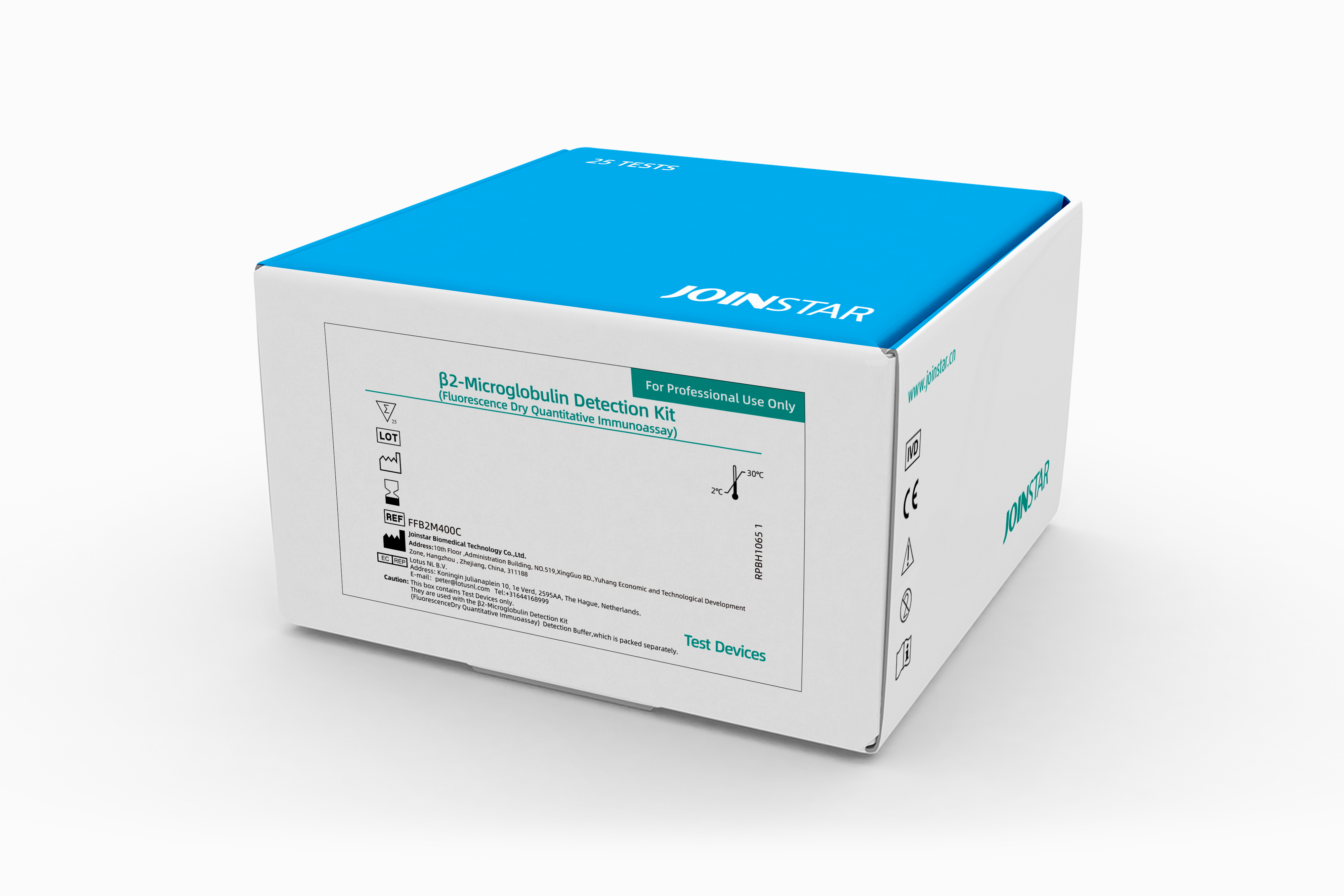
| Kit Name | β2-Microglobulin Detection Kit |
| Method | Fluorescence dry quantitative immunoassay |
| Assay Measuring Range |
Serum/Plasma Sample : 0.4 mg/L ~ 20.00 mg/L Urine Sample : 0.15 mg/L ~ 8.00 mg/L |
| Incubation Time | 10 min |
| Sample Type | Serum, Plasma(EDTA), Urine |
| Reference Range | 1.00 mg/L ~ 3.00 mg/L |
| Storage and Stability |
Detection Buffer: Stable for up to 12 months (Store at 2°C–8°C in a sealed, dark environment). Reaction Plate: Stable for up to 12 months (Store sealed at 2°C–30°C). |
Order Information
| Catalog No. | Product | Test/Kit |
| FFB2M400C | β2-Microglobulin Detection Kit | 25 |

Introduction
β2-microglobulin (β2-MG) is a small molecular globulin produced by lymphocytes, platelets and polymorphonuclear leukocytes with a molecular weight of 11,800.
It is the β chain (light chain) of human lymphocyte antigen (HLA) on the cell surface. . It is widely found at very low levels in plasma, urine, cerebrospinal fluid, saliva.
In healthy people, the synthesis rate and release amount of β2-MG from the cell membrane are constant. β2-MG can be filtered freely from the glomeruli, and 99.9% of filtered β2-MG are reabsorbed and degraded by proximal renal tubules.
In conditions where the function of glomerulus or renal tubule is altered , the level of β2-MG in blood or urine will also change.
The level of β2-MG in serum can reflect the filtration function of glomerulus and thus the level of β2-MG in urine is a marker for the diagnosis of proximal renal tubules damage.
Clinical Applications


Assessment of glomerular filtration function
The main reason for the increase of β2-MG in blood and the normal β2-MG in urine may be the decrease of glomerular filtration function, which is commonly in acute and chronic nephritis and renal failure, etc.
Assessment of renal tubular reabsorption
The level of β2-MG in blood is normal but increases in urine is mainly due to the obviously impaired renal tubular reabsorption, which is found in congenital proximal renal tubules function defect, Fanconi syndrome, chronic cadmium poisoning, Wilson's disease, renal transplant rejection, etc.
For Other diseases
Elevated levels of β2-MG may also be seen in cancers involving white blood cells, but it is particularly meaningful in people newly diagnosed with multiple myeloma.