






 Home
Home
 Products
Coagulation
D-Dimer
Products
Coagulation
D-Dimer
D-Dimer
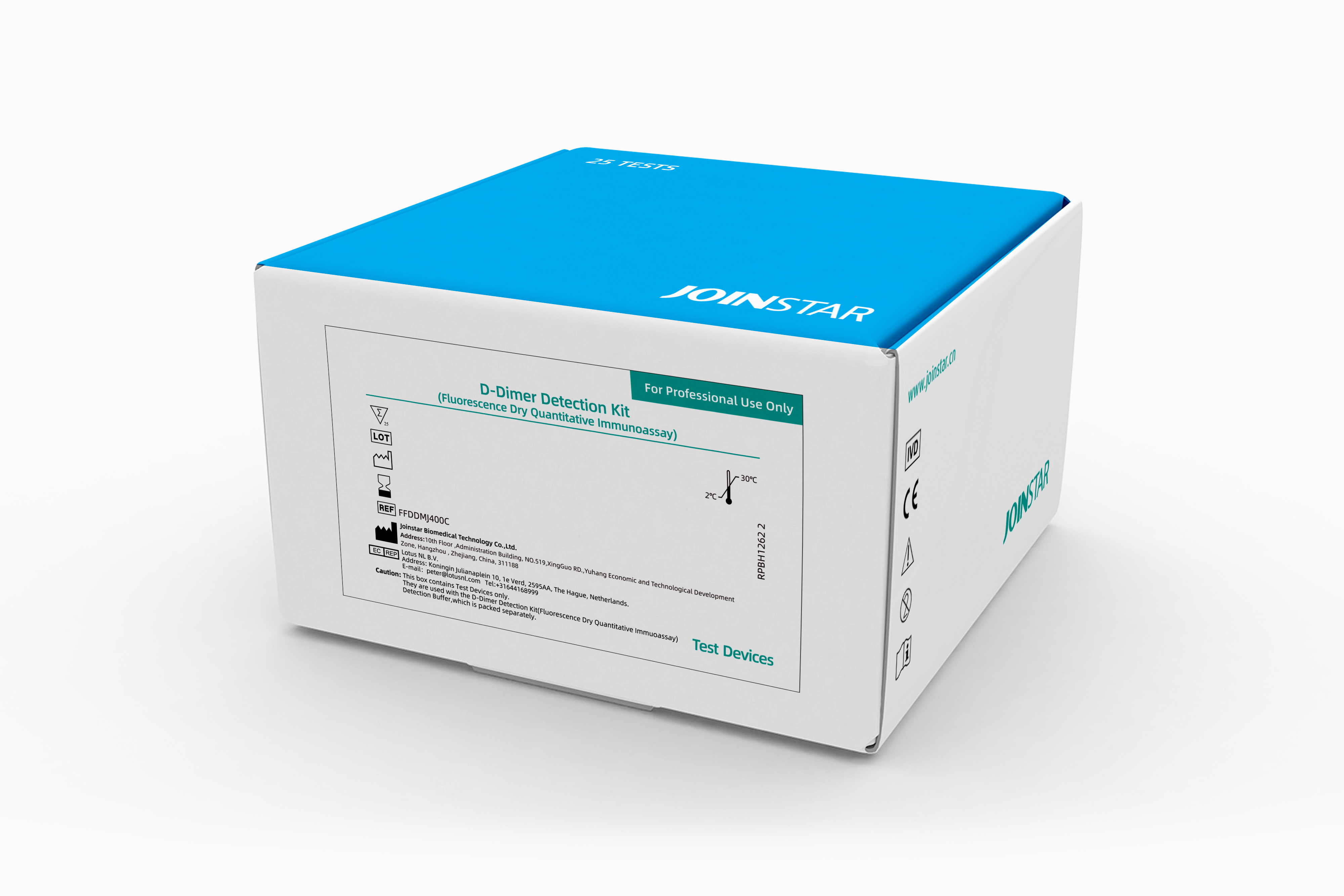
| Kit Name | D-Dimer Detection Kit |
| Method | Fluorescence dry quantitative immunoassay |
| Assay Measuring Range | 50 ng/mL ~ 10000 ng/mL |
| Incubation Time | 12 min |
| Sample Type | Plasma (EDTA), Whole Blood (EDTA) |
| Reference Range | < 550 ng/mL |
| Storage and Stability |
Detection Buffer: Stable for up to 12 months (Store at 2°C–8°C in a sealed, dark environment). Reaction Plate: Stable for up to 12 months (Store sealed at 4°C–30°C). |
Order Information
| Catalog No. | Product | Test/Kit |
| FFDDMJ400C | D-Dimer Detection Kit | 25 |

Introduction
•The fibrin monomers crosslink with thrombin activated factor XIII to form cross-linked fibrin. D-Dimer is a final degradation product of the cross-linked fibrin that is hydrolyzed by fibrinolysin. It is one of the specific fibrinolytic process markers. •The level of D-Dimer in the peripheral blood of healthy people is very low, and it increases significantly in various hypercoagulable states and secondary hyperfibrinolysis •D-Dimer has a half-life of approximately 8 hours in the circulating blood and is cleared by the kidneys and reticuloendothelial system.


Clinical Applications


Exclusion diagnosis of venous thromboembolism (VTE)
The most important clinical value of D-dimer testing is for the exclusion of venous thrombotic disease (VTE).
Prediction of Venous Thromboembolism (VTE)
In patients hospitalized with acute illness, elevated D-Dimer levels at admission (>500 ng/mL) can be used as an indicator for the subsequent development of VTE.
Diagnosis of diffuse intravascular coagulation (DIC)
D-Dimer is elevated at the early stage of DIC and can continue to rise as the disease progresses, it is therefore an important indicator for the diagnosis, severity and prognosis of DIC.
For Other disease
Screening and exclusion of acute aortic dissection (AAD), adjuvant diagnosis of acute coronary syndrome (ACS), diagnosis and prognostic judgment of cerebral infarction, adjuvant diagnosis and prognostic evaluation of sepsis, monitoring of hyperemesis, adjuvant diagnosis of malignancy, post-surgical thrombosis monitoring, monitoring of thrombolytic therapy, etc.